
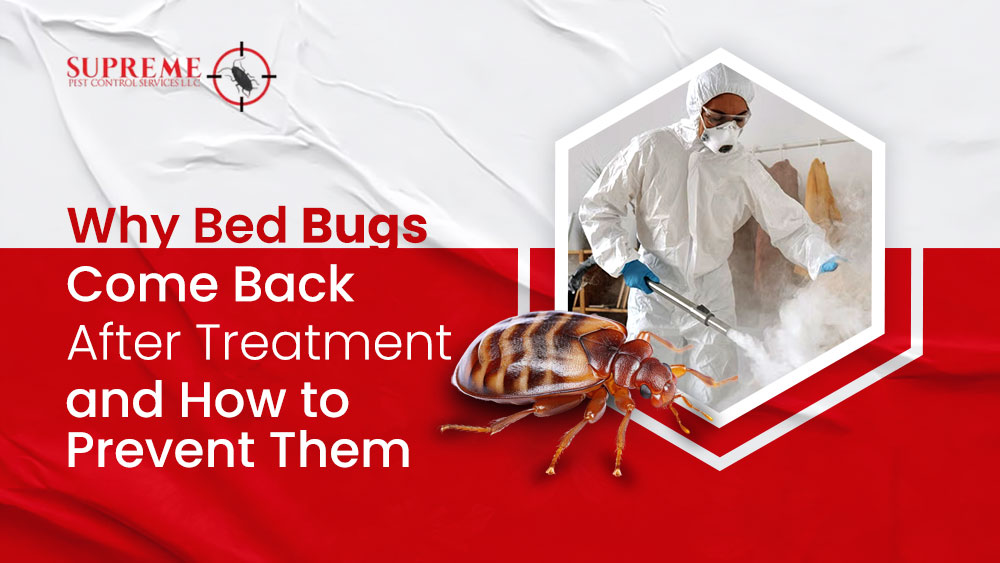
Bed bugs coming back post-treatment is one of the most frustrating scenarios that homeowners deal with. The problem is never the treatment, but it is happening around it.
You had a treatment done, and as a result, the bites stopped for a few weeks. But one morning, you wake up scratching your back again.
You pull up the corner of the mattress and there it is – you see live bed bugs again.
Bed bug recurrence is confusing, especially when you followed the instructions, cleaned your rooms, and stayed out for the needed hours. So, what brought them back?
The answer can never be a failed treatment, but a few specific things, which, once you understand them, can stop the recurrence cycle instead of just repeating it. So, what must have happened?
Why Bed Bugs Return After Treatment: The Most Common Cause
-
The eggs must have survived
This is a common reason. Contact insecticides are mainly spray-based treatments that most local pest control companies use as the primary method of killing bugs on contact, like nymphs, adults, and bugs crawling across the surface. The residual effect stays potent for some days post-application.
Bed bug eggs are physically resistant to insecticides. The shell of the egg is tough to protect the embryo from any chemical contact. Eggs are found on mattress seams, inside tiny wall cracks, and bed frame joints, and they survive treatment, hatching in around 10 to 14 days.
Local treatment kills only the visible population. 14 days later, a new batch of nymphs hatches. Within the month, they have started feeding, and within just a few months, there are enough adults that re-infest the places.
Solution? Follow-up sessions to monitor and regulate the recurrences. Generally, these follow-up sessions are conducted after two weeks of the first kill, which is an ideal time to catch and treat the new generation of bugs from eggs. Professional bed bug control can help address these recurring infestations through follow-up treatment.
-
The infestation was not fully mapped
Bed bugs are not only found in beds despite their names. They hide in warm, dark, and confined spaces where you regularly sleep. The bed frame and mattress are the most obvious spots.
But in case of a well-established infestation, they often spread further, behind the headboard into the sofa, nightstand, behind picture frames, electrical outlets, and even in gaps between the wall and skirting board.
If the treatment only targets the bed frame and mattress, it misses every other place where the bugs survive. They do not starve, but they wait. Once the pressure from treated areas lifts, they can move in.
This is why a proper inspection is required before a bed bug treatment. An infestation expert who spends merely five minutes on a surface before spraying the chemical is not doing the real work. Invariably, there will be live bed bugs missed in spots that were not inspected properly. A thorough inspection is an essential part of effective bed bugs control.
-
You bring them back inside the house
This is also what people miss mostly, but it is one of the main reasons for reinfestation as well. People who frequently travel are susceptible to bringing bed bugs because the insects travel too.
They hide in luggage seams, laptop bags, clothing, and jacket folds. Places like shared accommodation, buses, trains, and hotels are active places where bed bugs from someone else’s home travel to yours.
In case you have a successful treatment in January and go for a work trip in April, and stay in a hotel, then you must check your luggage to be sure that no insects have travelled with you back home.
In buildings and apartments, reinfestation can also take place from a neighbouring unit. Bed bugs can easily move through electrical conduits, shared walls, and under doors. If neighbours have an untreated infestation and you share a ceiling or wall, you are at risk of infestation or reinfestation as well.
-
The treatment method was not right in the first place
Store-bought insecticides and sprays are built for only surface-level treatment. They work only on the bugs that can be seen and reached. They cannot reach inside the hollow cavity of the wooden bed frame joint. They cannot kill eggs.
Bug bombs or foggers are counterproductive for bed bugs. Bed bugs sense fog and move away from the infestation and hide deep inside the furniture. When the fog clears, the bugs come back. Studies have also shown that foggers are essentially ineffective for bed bug infestations, and pest professionals know this.
Even professional treatments have limitations. A chemical spray treatment with proper follow-up works wonders for moderate to light infestations. For deep infestations spread across walls, rooms, and upholstered furniture, it is a harder job and calls for heat or steam treatment, which kills at every life stage, including the eggs.
A wrong method produces a partial result, which feels like failure but is just an incomplete fix.
- What stops bed bugs from returning
There is not one trick, honestly. Preventing bed bugs requires many things to take place at the same time.
The treatment must reach all harborage areas and not just the mattress. This is done through inspection and treatment of every room and piece of furniture where bugs are found.
It needs to account for the eggs, either with a follow-up visit for catching the next generation or killing the eggs with steam or heat treatment.
After treatment, the mattress must go into a proper encasement, which is a six-sided cover, zippered and completely sealed. This eliminates the chances of any surviving bed bugs and recurrence. Bed bug interceptor traps are placed under every bed leg to monitor for activity without having to pull the setup apart every week.
Luggage must be checked after every trip before coming back. Also, in case you are buying second-hand furniture, inspect it well before getting it inside your home. Such habits may sound tedious, but they efficiently reduce chances for bed bug reintroduction at home. These steps can also support long-term bed bug control.
Trust Supreme PCS for eliminating bed bugs, once and for all
Eliminating bed bugs needs more than just a one-time spray; it needs a systematic plan of treatment that targets both the eggs and adult bugs to prevent reinfestation.
Supreme Pest Control Services follows an end-to-end and tailored approach that begins with a thorough inspection and continues with family-safe, eco-friendly solutions. They also extend their support post-service for minimising the risk of recurrence. Their approach to bed bug control focuses on identifying and treating the source of infestation.
As a Dubai Municipality-approved pest control company, Supreme PCS performs all services in-house, without any subcontracting, ensuring safety, quality, and accountability.
Why businesses and homeowners trust Supreme Pest Control Services:
- Suitable for both commercial and residential properties across Dubai
- Transparent process with ongoing guidance and customised treatment
- Post-treatment support for helping prevent bed bug recurrence
- Experienced in-house pest control specialists without subcontracting
- Modern techniques that are designed to eliminate both eggs and adult bugs
- Family-safe, eco-friendly, and pest-targeted treatment solutions
- Customised bed bug treatment plans based on the severity of infestation
- Dubai Municipality-approved pest control company
Conclusion
Bed bugs can come back if hidden eggs survive the first treatment, which fails to address the source of infestation. Combining professional treatment with correct preventive measures is the most effective way of achieving results that last. Select an experienced pest control provider like Supreme Pest Control Services, ensuring a thorough inspection, practical post-service guidance and targeted treatment to minimise the risk of recurrence. With the correct expertise and consistent vigilance, keep your home as well as business free from bed bugs for the long term.
Frequently asked questions (FAQs)
1. Why do bed bugs come back after professional treatment?
Bed bugs can return when their eggs survive the initial treatment or if new bugs are introduced through clothing, furniture, or luggage. Proper preventive measures and follow-up treatments are crucial for eliminating a complete infestation and maintaining effective bed bug control.
2. How long does it take to eliminate bed bugs?
The timeline for complete bed bug elimination depends on the severity of the infestation and the treatment method used. Most professional treatments require one or more follow-up visits to ensure that all bed bugs, as well as newly hatched eggs, are eliminated.
3. Can bed bug eggs survive pest control treatment?
Yes. Some bed bug eggs can survive some treatments, as they are resistant to a lot of pesticides. The professional pest control companies often suggest follow-up inspections as well as treatments for targeting newly hatched bed bug eggs.
4. How can I prevent bed bugs from coming back after treatment?
Regularly wash bedding, frequently vacuum, inspect second-hand items, reduce clutter, and use mattress encasements. Following your pest control post-treatment instructions also helps minimise infestation risk.
5. Can I get rid of bed bugs without professional pest control?
DIY methods may reduce the number of bed bugs but rarely eliminate an entire bed bug infestation. Professional pest control offers targeted treatments and expert inspections, which offer more long-lasting and reliable results.

supremepcs